

How to Make Dandelion Salve How to Make Dandelion Salve How to Make Dandelion Salve
Just before we were about to go away on our holiday, up leaps Jonathan declaring “Now’s a good as time as any!’
‘Eh?’ I eloquently replied in question as he purposefully strode outside with me trotting after him in curiosity.
“To mow the lawns!” he announced. Ah, nothing too earth shattering then.
As I cast an eye over the grass, yellow heads swayed and bobbed in the breeze. Dandelions (Taraxacum Officinal) otherwise known as Lion’s Teeth – dent de lion in French (note the shape of the leaves), P!ss-in-the-bed, (pissenlit) pardon my French, on account of its diuretic effects when eaten, Fairy Clock, Swinesnout, Cankerwort, Priests Crown and many more nicknames.
Within reason, we like to leave our lawns untouched for as long as possible so the wonderful array of dandelions, self-heal, forget-me-knots, hawkbit and clover have a chance to feed the bees and butterflies. It seemed a shame to condemn the flowerheads to the compost bin so I sprang into action and collected as many as I possibly could with the intention of making a Dandelion salve before the blades of the mower whirred into action.
To go straight to the video, click here or read on for more details.
I would love to, if I can, convert anyone’s notion of dandelions being merely pesky weeds. That couldn’t be further from the truth. They are in fact one of nature’s greatest medicines with every single part of the plant being safe and effective to use. It is regarded as one of the best herbal remedies for kidney and liver complaints.
Benefits & Uses – how long have you got?!
Nutritionally, dandelions are packed full of vitamins – A, C, K, E, B, minerals – calcium, magnesium, iron, potassium and fibre as well as powerful antioxidants such as beta-carotene and polyphenols.
Leaves:
Use young leaves in salads and stir-fries to help kidney function. Tip: blanch first to help get rid of some of the bitter flavour.
Fresh or dried leaves can be made into a tea said to:
- Be a diuretic without leaching potassium from the body
- Reduce bloating
- Clear out waste
- Support the immune system
- Help with high blood pressure
- Aid digestion
- Alleviate constipation
- Help protect the liver from cellular damage caused by free radicals
- Help to keep teeth and bone healthy
- Be Prebiotic – encourages the growth of good bacteria in the gut
- Historically it’s also been used as an appetite stimulant.
Roots:
- The root is a mildly laxative, bitter tonic valuable in treating dyspepsia and constipation.
- Roasted roots can be made into a caffeine-free tea or coffee. The bitter taste can be sweetened with a little honey.
- You’ve probably already heard of the drink Dandelion & Burdock.
- Dye – a yellow-brown dye can be made from the roots
- The roots are excellent food for pet rabbits, guinea pigs and gerbils
Latex (the milky sap in the stem)
The latex is said to be effective for removing corns, warts and verrucas. Apply the sap daily to the affected part.
Flowers
The flowers can be boiled with sugar to make a cough syrup or cordial.
Other Uses
As a fertilizer with a good supply of copper. Put 3 whole dandelion plants – flower, stem, leaves and root into a bucket, pour over 1 litre of boiling water, cover and allow to stand for 30 minutes, strain and use (it won’t keep).
Interesting Facts
Dandelions are one of earths enriches. Their wide-spreading roots help to break up impacted soil and restore soil and mineral content. The nutrition that they draw up such as calcium and nitrogen helps to feed other plants around them when they naturally die.
Over the centuries, all over the world, in many different cultures, the humble dandelion has has been wildly used in herbalism to help cleanse toxins from the body, treat stomach & liver complaints, lower blood pressure and treat diabetes and inflammation.

And of course, how could I leave this article without the reminder that should you have a wish that needs granting, you can of course blow the seeds from a dandelion clock in order for it to happen 😉
soul
In addition to granting wishes, many people believe that dandelion seeds will carry your thoughts and dreams to loved ones when you blow them into the air.
If you fancy having a go at making the Dandelion Salve I made, here are the ingredients I used:
jumptoit
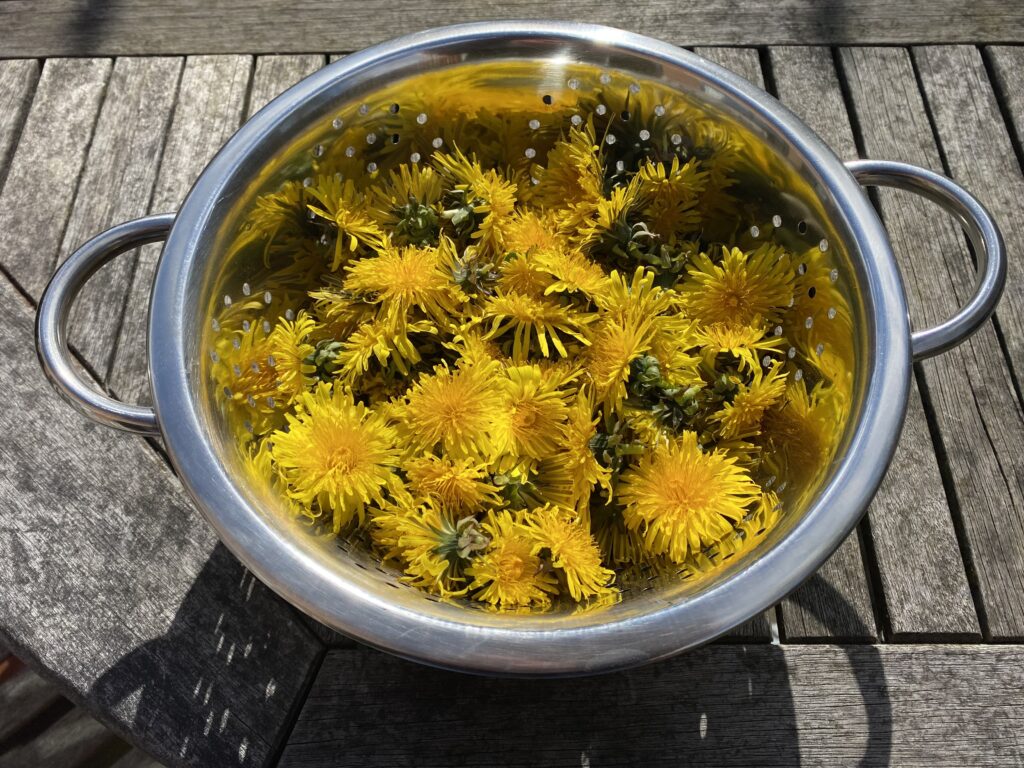
Dandelion flowers of course! I filled a colander 3/4 full of them. Make sure they haven’t been sprayed with pesticides, aren’t gathered from high traffic roadside or are likely to have been watered by dogs!
250 ml/ one cup of good quality olive oil*
28g/1 oz of organic beeswax pellets
28g/1 oz of organic shea butter
12 drops of Lavender essential oil
Sterilised jars – wash with hot soapy water and place in a cold oven. Heat oven to 160°C/320°F and leave jars in for 20 minutes.
Method:
Remove the petals from the dandelion heads and ideally allow them to dry for a day or so as moisture in the petals may react with the oil.
Pack the petals in a jar and cover with the oil. Shake well. Leave for around 2 weeks to to infuse in a cupboard.
Strain the petals from the oil through a muslin cloth.
Place the dandelion oil in a bowl over a simmering pan of water (bain marie), add the beeswax pellets, stirring occasionally until melted.
Add the shea butter and allow to melt.
Turn off the heat and allow to cool for about 30 minutes.
Add your choice of essential oils. Stir to combine.
Pour into jars. Allow to cool fully and then keep refrigerated. Should keep for 12 months.
*Alternate oil suggestions – jojoba oil, sweet almond oil, fractionated coconut oil.
Uses so far for me:
- Great as a lipsalve
- Great on dry/cracked skin including heels
- Great hand cream
- Great as a night cream on face
As dandelions are anti-inflammatory, the salve is said to be good for soothing tired, sore, aching muscles and joints.
Finally, I hope you’ve enjoyed this information and that I’ve managed to persuade you that dandelions are not weeds, they are an amazing gift of nature! You can check out more of my Nature’s Medicine recipes here

Please note that I am not a qualified herbalist, my findings are based on my own extensive research and I would ask you to do your own thorough research on the safety of using plants for consumption or external use, should you wish to use them. Please ensure you are 100% sure of the identity of any plant before using it, there may be harmful look-a-likes that need to be avoided at all costs. I recommend investing in a plant identification book, more than one ideally and always cross reference any information with several sources. Any health concerns should always be discussed with a medical professional.
Find us on Facebook
Find us on Instagram
Find us on Twitter
Find us on YouTube