A Useful Hint
by Aaron Hill (1685-1750)

TENDER-HANDED stroke a nettle,
And it stings you for your pains;
Grasp it like a man of mettle,
And it soft as silk remains.

'Tis the same with common natures,
Use them kindly they rebel;
But  be rough as nutmeg graters,
And the rogues obey you well.
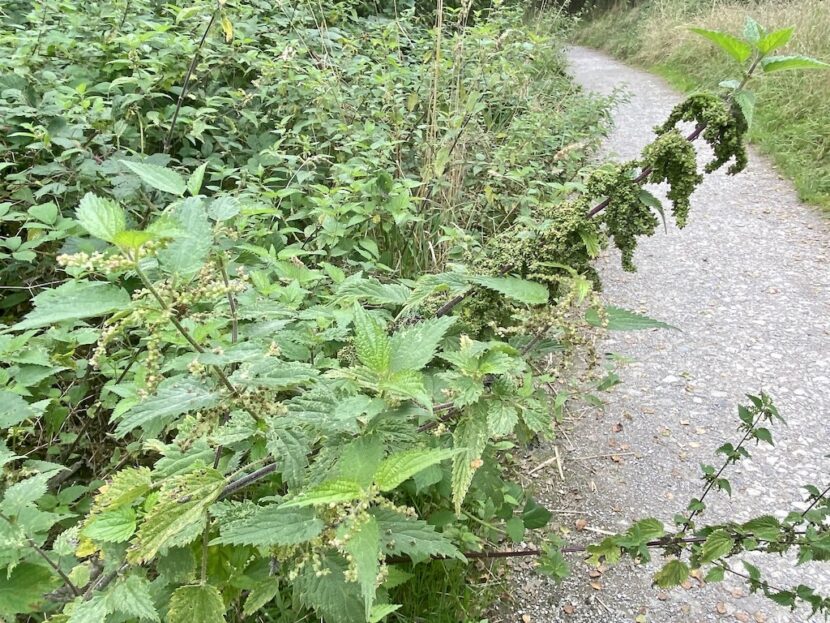
Out of all of the ‘new things’ I’ve learned this week, one in particular made me ‘Oooh & Aaah!’ the loudest. I can’t remember exactly how I came across it but my curiosity was aroused by discovering that a stinging nettle – Urtica dioica is either a male or female plant! Now I know it’s not ground-breaking news and positively boring for some but please bear with me, this wildly abundant plant has a tremendous amount of health benefits, some of which I shall shortly reveal
I’m pretty sure that we all know what a nettle looks like. Most of us learned early on in childhood to avoid brushing it with our bare skin and I’m sure we’re all familiar with the stinging bumps that appear if we happen to have a run in with one.
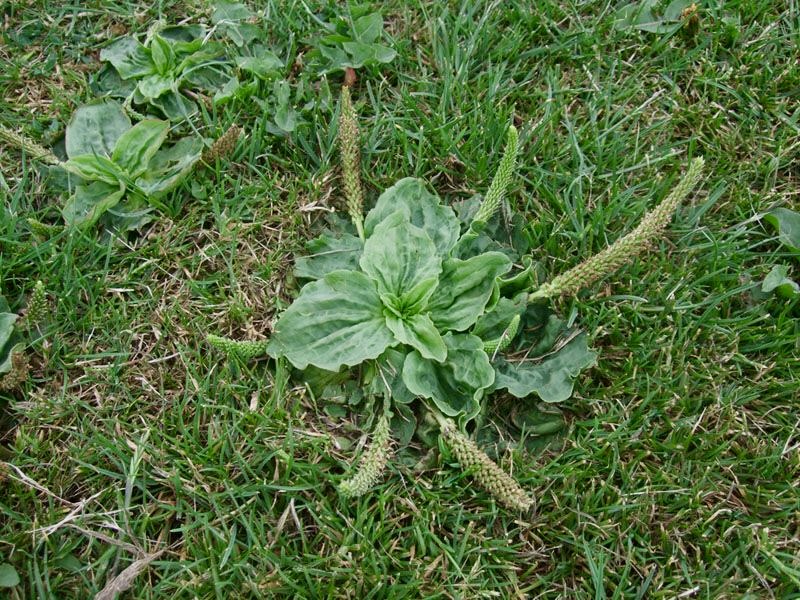
Tip: forget about rubbing an affected area with a dock leaf to alleviate the sting, despite what we were told as children, it won’t work, it’s a placebo. Instead look for Greater Plantain and crush one of those leaves by screwing it up into a ball and rubbing it between the palms to release the sap, it works wonders on nettle stings as well as insect bites. Here’s an article about the wonders of Plantain I wrote last year. I bet you’ll recognise it in this photo.
It is alleged that Roman soldiers introduced nettles into the UK using them to keep damp-climate illnesses away and flogging themselves with it to keep warm. Personally I can think of lots of different ways of keeping warm that aren’t painful in the slightest and in that famous Monty Python sketch that asked ‘What have the Roman’s ever done for us?’ I don’t think they mentioned how to keep warm the nettle way! Joking aside, the stinging nettle offers us many health benefits. It’s debatable whether the Romans actually did introduce nettle to the UK, you’ll find arguments for and against if you wish to delve further. It does seem though that they did use it for medicinal purposes.
Should you be inclined to take hold of a nettle with your bare hands, the Useful Hint suggests that you grasp it rather than gently stroking it to avoid it’s sting.
Grasp it like a man of mettle
Aaron Hill (1685-1750)
Whilst the prose can be taken metaphorically, such as fortune favours the bold, there may be an element of truth about grabbing a nettle with gumption to prevent you from being stung. Here’s why:
The hairs that you see covering the leaves and stems are actually hollow, like hollow needles, and when brushed against, they inject toxins into the skin which causes the stinging rash. The theory is that if the plant is firmly grasped in the direction that the hairs are growing, the hairs are pushed flat and cannot penetrate the skin. There will be many that tell me that this theory is true, none the less, I shall not be putting it to the test myself! Having said that, from ancient times ‘urtication’ or flogging oneself with stinging nettles was used to stimulate circulation, bring warmth to joints and as a relief for arthritis and rheumatism, so perhaps the Romans did know a thing or two after all.

Nettle uses:
The tough stem of the nettle can be used for string and cord making.
Rich in iron, calcium, magnesium, phosphorus, potassium and sodium, vitamin A, C, K and several B’s, the leaves are wonderfully nutritious and can be used to make soup, tea, tinctures, skin creams and even beer! The nettle tops can also be used as wild spring greens, lightly steam as you would spinach. Avoid harvesting the leaves when the nettles are in flower (June to October) as they can be a laxative and contain cystolith crystals which may irritate the urinary tract. The great thing about nettles though is that you can cut them back and harvest the new growth throughout the season.
Tip: when foraging always stay away from plants on dog walking routes or as Marlow from Wild Food UK says:
Forage above Great Dane height
Marlow, Wild Food UK
Wise advice!
The seeds are said to be good for your skin and hair, your brain, supporting the kidneys and strengthening the adrenals. They may help you cope with stress and are said to induce the feel-good factor, increase energy and vitality, hardly surprising when they are loaded with minerals and trace elements!
I’ve used the leaves in various ways before but never the seeds, so this week’s project was harvesting, drying and trying them!
Only the female plants produce seeds. So how can you tell the difference?


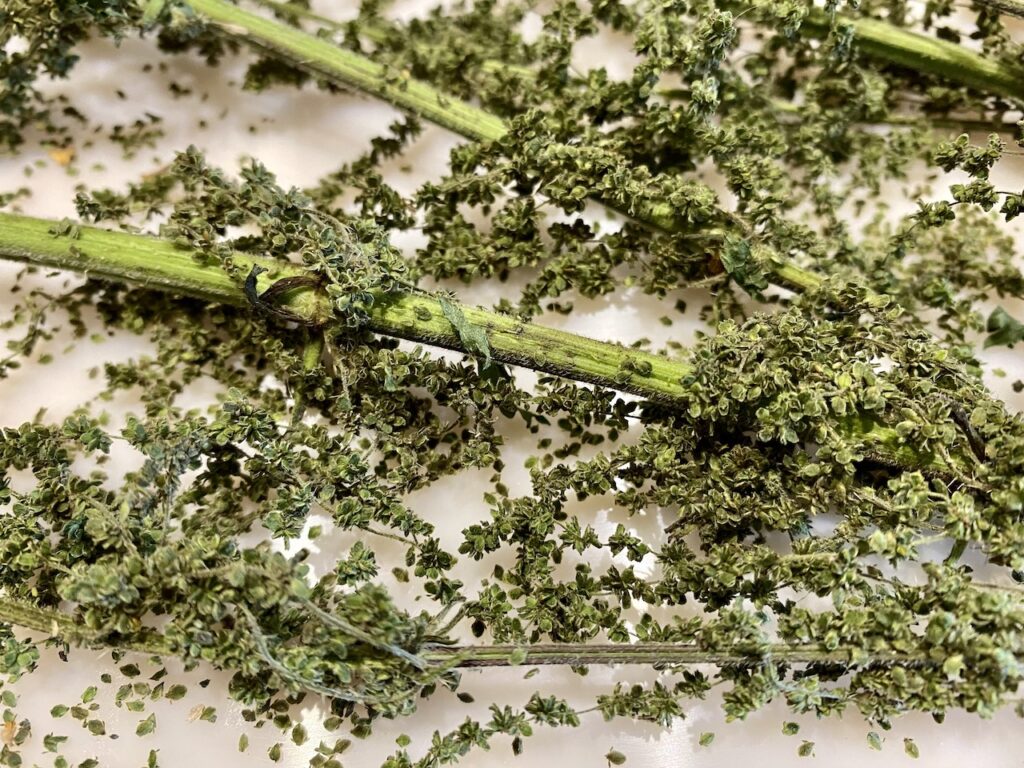
When the bunches of seeds droop towards the stem; they are ready to pick, remember never to pick more than 20% from any one plant to enable it to reseed. You can eat the seeds fresh, simply rub them through your fingers onto your palm to remove any stinging hairs, or dried. Drying is easy, simply cut the stems and hang them in a dry place out of sunlight. This also allows any little hitchhikers to escape. Tip: Have a tray underneath to catch any falling seeds. Once dried, push them through a sieve them to remove any stinging hairs. You can use the seeds in soups, smoothies, stews, salads in fact use them as you would poppy or sesame seeds. You can even eat them straight from a spoon starting with a teaspoonful and working your way up to a tablespoonful if your body is ok with that.
I do hope that this little article has aroused your curiosity and that you’ll delve deeper into the wonders of stinging nettles. If you do go to harvest some, remember, pack some gloves!
You’ll find a list of nettle health benefits at:
https://www.healthline.com/nutrition/stinging-nettle
https://www.medicalnewstoday.com/articles/325244#arthritis
https://www.ncbi.nlm.nih.gov/pmc/articles/PMC4708629/
https://www.ncbi.nlm.nih.gov/pmc/articles/PMC4708629/#fsn3259-bib-0004
Caution:
Please note that there is no official safety information on consuming nettles for pregnant women or children, so I would always recommend erring on the side of caution. As many herbal remedies can interact with medication, it is important to always consult your GP before taking any. Stinging nettles may interact with blood thinners, high blood pressure, heart disease and diabetes medication.
I am not a qualified herbalist or botanist therefore I encourage you to do your own extensive research on any plant you intend to forage and to be 100% certain that you have identified it correctly. New foodstuffs can cause allergic reactions so only ever try a small amount in the first instance and if you have any doubts whatsoever, leave well alone.

Ann founded Holistic Wellbeing in 2008 and today runs the business full time alongside her husband Jonathan. Ann specialises in the spiritual development of others on many levels. A teacher of Meditation, QiGong and Original Usui Reiki, Ann is an intuitive facilitator of healing through the mediums of Emotional Freedom Technique and spiritual practice.
Ann holds one to one therapy sessions, private meditation & QiGong classes for health and wellbeing as well as co-hosting weekly psychic evenings and psychic development courses, classes and workshops. She is also the events, promotions and advertising manager and is responsible for the day to day running of the centre. To find out more about Ann click here or contact her on: 01484 76722, email: Ann