

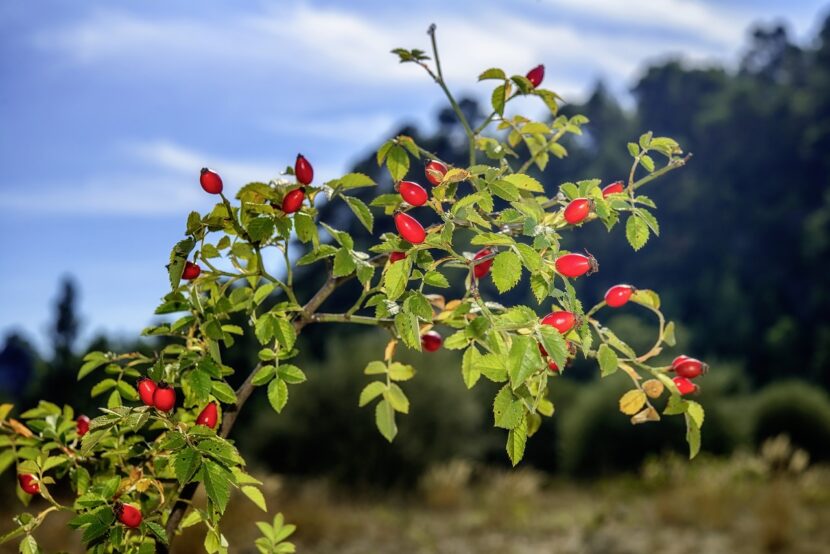
The kids are back at school, autumn is gently creeping in and nature is displaying bounties to be harvested. So what better natural way to help us build up our strength and resistance for the winter ahead by making the most of what the hedgerows have to offer. This week I’ve been busy in the kitchen making Rosehip Syrup and Rosehip Vinegar. Rosehips contain a wonderful supply of vitamins: A, B and K and minerals too. In the 1930’s it was discovered that they contained 20 to 40 times more vitamin C than oranges!
During the second world war in Britain, school children were paid 3d a pound to collect rosehips and by 1945, 450 tonnes were gathered each autumn to be turned into a syrup to help support the body’s immune system and help fight cold and flu symptoms, sore throats, chestiness and runny noses. I wonder how many were actually used for itching powder pranks as in case you don’t know, rose hips contain a cotton-like substance called cythilicus, the very stuff that causes an itch! The hairs on the rosehips are an itchy irritant too, so unless you’ve got leather hands like mine, I’d recommend gardening gloves for handling them!
If you fancy having a go at making a delicious elixir yourself, here’s what I got up to:
Rosehip Syrup
Equipment:
Glass bottles and stoppers – I used 250ml bottles.
Muslin or cheese cloth, I used 4 squares
Large Pan
Large Sieve, sterilized
Funnel, sterilized
Food Processor or chopping knife and board
Ingredients:
Rosehips! Now I did weigh them, wrote the weight down and promptly lost the bit of paper! I’m good at that. So if my memory serves me, I’m going to hazard a guess that it was around 750g, It’s not like baking a cake, so you don’t have to be too exact.
1.3 litres of cold water, although that sounds exact doesn’t it! 😉
Caster sugar – 325g per 500ml of the end produced liquid
Method:
I read somewhere that rosehips are best gathered after the first frosts but as someone pointed out, that isn’t always practical so to compromise, I froze the hips and then let them defrost before using. You don’t need to do this step and in that case, I would recommend using your rosehips as fresh as possible.
Sterilize your glass bottles by washing them in hot, soapy water, rinsing well then put them in a cold oven to dry and set the temperature to 120°C. Once the oven reaches temperature, leave on for around 10 minutes then switch the oven off but leave the bottles in so that they remain hot for when it’s time to add the syrup. I sterilized the stoppers by steaming them for 10 minutes. I also steamed the sieve and boiled the muslin squares to sterilize them too (see photo). Whatever you’re using, you’ll find various sterilizing methods on the internet.

Roughly chop the rose hips in a food processor or if you are hand chopping, remember to protect your hands!
Place chopped rose hips into a large pan and add the water.
Bring to the boil simmer for around 15 minutes.
Strain the hips and water through a double layer of muslin and let the pulp sit for around half an hour so that all the juice passes through, or you can be impatient like I was and hop around whilst trying to wring out the boiling pulp with your bare hands (not recommended)
Using another double layer of clean muslin, or discard the hips and wash out the ones you’ve just used, pass the strained juice through once again. This ensures no irritants sneak through.
Measure the quantity of juice, put it back in the pan (I washed my pan out first for good measure) and for every 500ml, add 325g of sugar. Yes I know it’s a lot but the end dosage is rather small. If you’re keen to avoid sugar, check out the Rose hip vinegar recipe below instead.
Bring the juice and sugar mixture to the boil, stirring until all the sugar has dissolved and simmer for 10 minutes.
Whilst the sterilized bottles are still hot, pour the hot syrup in using a sterilized funnel and seal the bottle.
Allow to cool then label.
Store the bottles in a cool, dark place for up to 4 months and once opened, keep it refrigerated and consume within 4 weeks if it lasts that long!
Dosage:
1 – 2 tsp per day as a preventative measure or as required for sore throats and colds.
It is also delicious poured over ice cream and used in desserts.
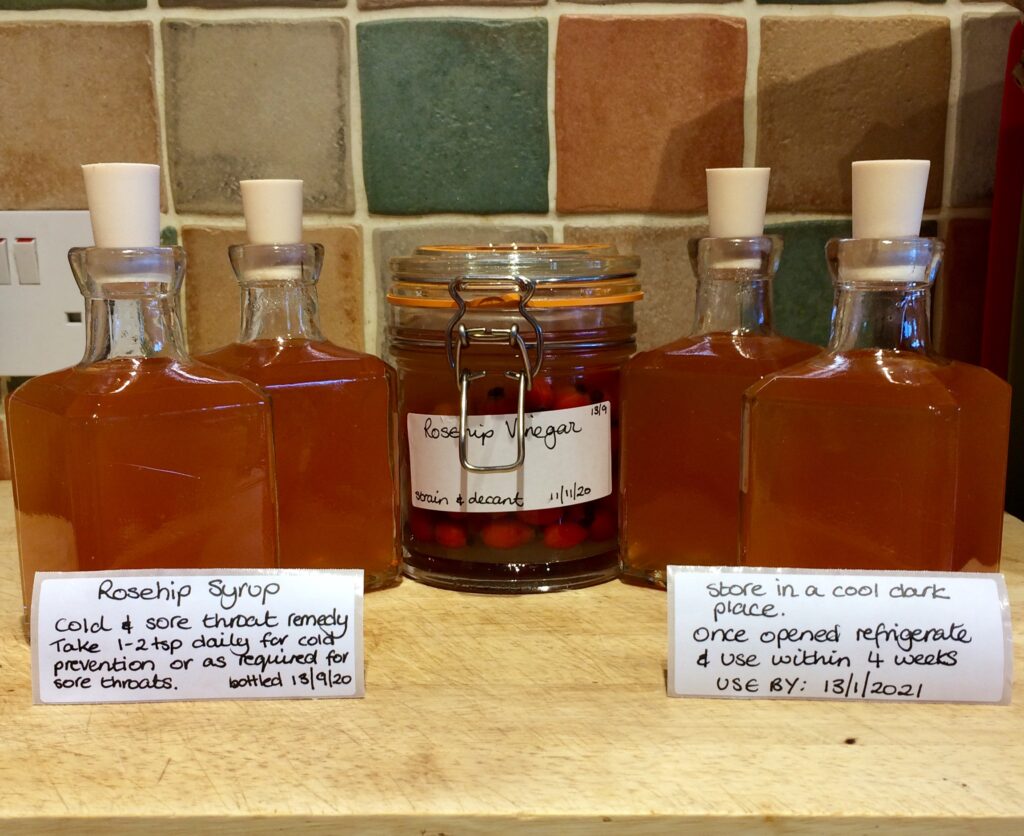
Rosehip Vinegar
Score around 20 or 30 rosehips with a knife, place into a wide necked jar and cover with apple cider vinegar (actually, I think I filled my jar half full and omitted the counting, it’s the free spirit in me coming out 😉
Leave the jar on a sunny (don’t laugh) windowsill for around a month, then strain and bottle.
The vinegar can be used in salad dressings or to treat sore throats, mix a tablespoon of vinegar with some warm pre-boiled water, gargle and then swallow. For colds, add a tablespoon of the rose hip vinegar to a mug of hot pre-boiled water and sweeten to taste with honey if you wish.
Oh and in case you want to know what else I’ve been up to in the kitchen, shhhh, come closer, *whispers* I’ve been making sloe gin after discovering some hidden Blackthorn bushes and with a plum tree in the garden groaning under the weight of a great crop this year – plum gin and plum vodka which should be nicely ready in time for Chr….. erm, you know, that celebration near the end of December. I refuse to use the C word until at least November 😉 Cheers!

Please note that I am not a qualified herbalist, my findings are based on my own extensive research and I would ask you to do your own thorough research on the safety of using plants for consumption or external use, should you wish to use them. Please ensure you are 100% sure of the identity of any plant before using it, there may be harmful look-a-likes that need to be avoided at all costs. I recommend investing in a plant identification book, more than one ideally and always cross reference any information with several sources. Any health concerns should always be discussed with a medical professional.
©Ann Halstead