


Yarrow – Nature’s First Aid Yarrow – Nature’s First Aid Yarrow – Nature’s First Aid Yarrow – Nature’s First Aid Yarrow – Nature’s First Aid Yarrow – Nature’s First Aid Yarrow – Nature’s First Aid Yarrow – Nature’s First Aid
Yarrow Achillea millefolium L.
Common names: Soldier’s woundwort, Devil’s nettle, Millefoil, Nosebleed, Staunchweed, Old Man’s Pepper.
I first became intrigued with the incredible plant Yarrow, when I attended the plant spirit course in Scotland earlier this year and learned about some of its fantastic wound healing properties. Most notably for me, Yarrow has the ability not only to stem blood flow in a first aid situation, it has a pain and inflammation reducing ability and its application can also speed up healing of the wound too. Yarrow offers us so much more but first here’s a little bit of folklore for you…
Folklore

Yarrow’s botanical name Achillea millefolium, translates to
‘Achilles’ thousand-leaved herb’.
Achilles was born the son of Argonaut Peleus, a mortal Greek King and Thetis, an immortal goddess of the sea. It was prophesied that he would either live long in obscurity or die young and obtain glory. His mother couldn’t bear the thought that he wasn’t immortal like her and thus she would outlive him, so she decided to take matters into her own hands and change his fate. In one version of the tale, Thetis was said to have held Achilles by his ankle and dipped him in the magical river Styx so that wherever the water touched him he would achieve immortality and invulnerability. In another version of the story, it was said that Thetis dipped him into a bath of yarrow tea for exactly the same reason.
Legend has it that half God Achilles, the greatest Trojan war hero of the Greek army, was mentored by Chiron the centaur, a teacher of the art of war and healer who taught Achilles all about the healing properties of Yarrow. Achilles used his knowledge of the plant on the battlefield to staunch the bleeding and heal his injured soldiers wounds.
In a cruel twist of fate, Achilles’ fatal wound made by a poisoned arrow, was to the heel beneath the ankle his mother held him by and which crucially had missed being dipped into the elixir of immortality. How unlucky!

Until my interest in Yarrow was piqued, I’d got no idea that we are literally surrounded by it and now I can’t fail to notice its appearance everywhere I go. It’s a hardy perennial that grows to a height of 30-90cm, with tough stems and feathery, fern-like leaves which earns it the name ‘thousand leaved’. In the wild, I’ve only every seen the white small cluster of flowers, ornamentally however, you can buy the plant in beautiful shades of yellow to a deep pink.
The photo, left, is of one I have growing in my garden called Achillea Millefolium Light Yellow. Note the shape of the ‘thousand leaves”
It’s found all over the world in wastelands, meadows and hedgerows. It’s an ancient herb discovered in Neanderthal graves. Our Anglo-Saxon ancestors had a great respect for its wound-healing properties and believed it had potency against evil. In the Middle Ages it was one of the many herbs used to make an early form of beer. In the ancient Chinese book of divination, the I Ching, 52 straight, dried Yarrow stalks of even length were originally cast prior to the use of three coins. It is said that the Druids used it to divine seasonal weather.
Old Superstitions
If an unmarried maiden wanted to discover who her future husband would be, she must pick Yarrow under the light of the full moon and place it under her pillow whilst reciting:
“Good night fair Yarrow,
Thrice goodnight to thee,
I hope before tomorrow,
My true love to see”
… her husband would be revealed to her in a dream.
If a young girl tickled her nostrils with sprays of Yarrow and her nose started to bleed, it would prove her lover’s fidelity. My thoughts are that she would then have to stuff the Yarrow up her nose to stem the blood flow and hope that her Love doesn’t find her in this not too attractive state!
“Yarrow away,
Yarrow away, bear a white blow?
If my lover loves me,
My nose will bleed now”
Maidens would pin Yarrow to their dresses and get as close to their suitors as possible. That night they would place the Yarrow in a drawer and should it still be fresh the next morning, they would find their love reciprocated.
Yarrow tea was used by witches to enhance their psychic powers and if they held the plant up to their eyes, they would be gifted the power of second sight. I’ll confess to using Yarrow tea but for a different reason entirely which I’ll explain shortly, so don’t burn me yet!
Properties of Yarrow:
- It is antiseptic, anti-inflammatory, anti-bacterial and astringent.
- The essential oil from the flowers is a good chest rub for colds and flu.
- Fresh leaves crushed between the fingers can be used to stop blood flow in an open wound or to staunch a nose bleed.
- A poultice made with dried yarrow and a little water can do the same.
Yarrow Tea
- Drinking yarrow tea encourages sweating to lower a fever and expel toxins.
- It can be drunk as a natural sleep aid.
- It may reduce stomach cramps and aid digestion.
- It may be used to treat the symptoms of PMS and menopause.
- It may relieve anxiety and depression.
- It may alleviate toothache.
Other uses
- Hang in your wardrobe to deter insects.
- The young leaves can be cooked like spinach or put into a soup.
- The dried and ground leaves can be used as a pepper substitute or on wounds.
- Herbalists find it useful in lowering blood pressure after a stroke or heart attack – consult a qualified herbalist if you would like to know more.
- Psychic Protection.
- An oil infusion.
- A poultice for hemorrhoids.
- In soothing skin creams.
- As a tincture for emotional healing and protection.
- A flower essence.
- In sacred smoke bundles.
How I’ve used it so far:
You may have read my blog Ancient Anglesey – Sacred Sites about our visit to some of the stone circles and standing stones on Anglesey, if not you can read it here. At one of the sites, Bryn Celli Ddu, the footpath that lead to the chamber was adorned with Yarrow and I simply couldn’t resist foraging some growing on this sacred site to take home with me. If you’d like to know more about what we discovered on our visits, Jonathan has written two much deeper articles that you can read here: Incredible Legacies of the Druids Part 1 and Incredible Legacies of the Druids Part 2
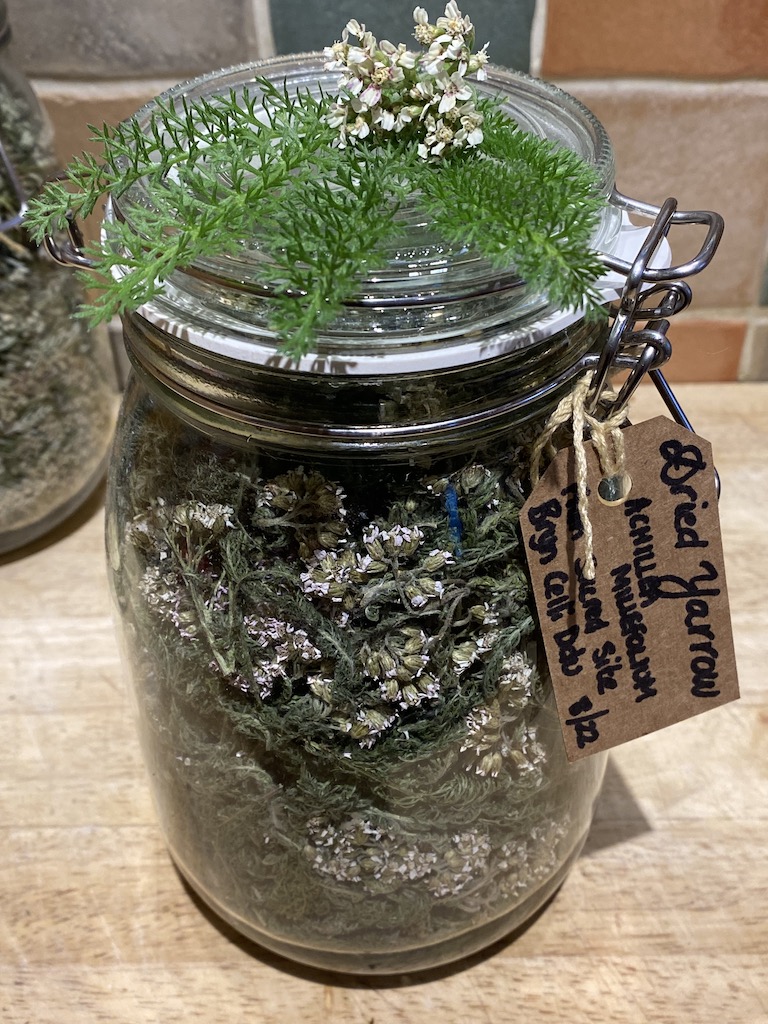
The Yarrow I collected was washed well as it came from a footpath, though it had no detectable odour of a doggy visitor and began its drying process in the tent back at our campsite. Once home it continued drying and is now stored in a mason jar in readiness.
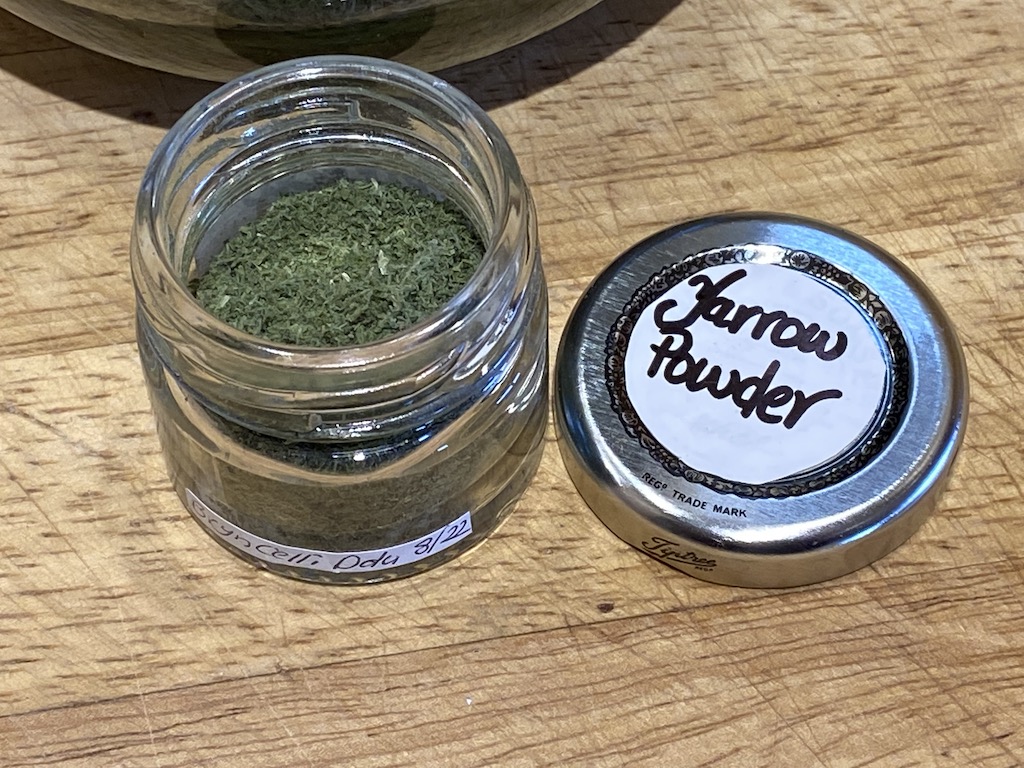
I have some finely powdered in a small jar which came in very useful to treat a cat scratch. Not only did it dry the blood flow almost immediately, it numbed the pain and by the next day there was no trace of the injury whatsoever.
I have also used it as part of a cold/flu treatment after I had one of those what I call ‘skin-crawly’ days when you feel like you’re about to come down with something. I decided on an early night and took a concoction of homemade Elderberry Rob with a teaspoon of raw honey and topped it up with hot Yarrow tea that had been steeping for 10-15 minutes. It was delicious and as I sat up in bed sipping the soothing drink, I filled it with healing intentions. The next morning I woke up as bright as a berry and not a sniffle in sight. Marvellous!
I haven’t used it as a spice in cooking but I have tasted it. I can’t quite put my finger on how to describe the flavour; it’s not hot like a black pepper, I’d say it’s more like a dried mixed herb. I will try and remember to give it a go in a dish and report back.
So that’s it on the amazing healing powers of Yarrow for now and I do hope you enjoy discovering the joys of it for yourself one day.
WARNING
If you are unfamiliar with Yarrow, that there are similar wild flowers that may be mistaken for it by the untrained eye such as Cow Parsley (mother die), Hogweed and the deadly poisonous Hemlock.

Please note that I am not a qualified herbalist, my findings are based on my own extensive research and I would ask you to do your own thorough research on the safety of using plants for consumption or external use, should you wish to use them.
Please ensure you are 100% sure of the identity of any plant before using it, as mentioned above, there may be harmful look-a-likes that need to be avoided at all costs. I recommend investing in a plant identification book, more than one ideally and always cross reference any information with several sources. Any health concerns should always be discussed with a medical professional.
Please forage responsibly taking only a small amounts and not all from the same plant so it has the opportunity to regenerate. Leave plenty for the wildlife. Always ask the Landowners permission before foraging on privately owned land and take care not to trespass.
Ann x
Find us on Facebook
Find us on Instagram
Find us on Twitter
Find us on YouTube