
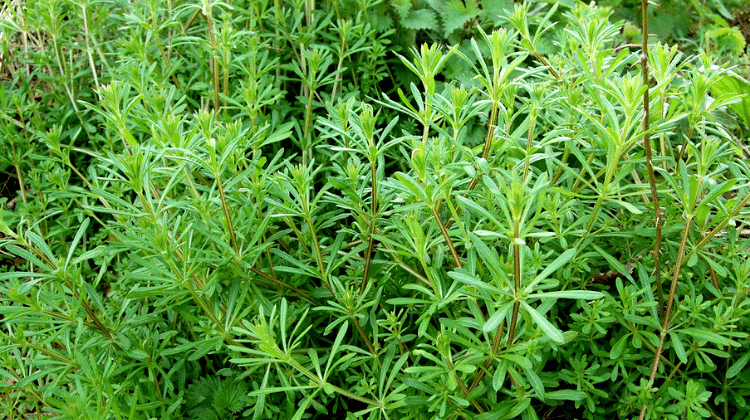
Cleavers – Galium Aparine
written by Ann Halstead
Cleavers. If you don’t immediately know what I’m talking about, think long sticky plant often found alongside footpaths, clambering over hedges and other plants that children and adults alike, love to surreptitiously attach to the back of their walking companion. You may be surprised to learn that it’s not actually sticky at all, the stems and leaves are covered with little-hooked bristles that help them ‘cleave’ to just about anything that brushes passed them.
Cleavers is known by lots of other names too – Goosegrass, Hayriffe, Goosebill, Sticky-willy, Catchweed, Robin-run-the-hedge to name a few. When I came across it growing abundantly in our garden recently, I wondered if there was anything I could do with it and to my delight the answer is yes! Very much so!
Cleavers is the earliest of the traditional spring tonic herbs to sprout and is a great remedy to cleanse the blood, strengthen the liver, stimulate the lymphatic system, improve the immune system and fluid balance. It is a deep acting cleanser and diuretic. Cleavers is the ultimate springtime herb and starts to appear when sluggish immune systems are in need of a boost.
Cleavers enhances the function of the lymphatic system and improves its ability to flush out toxins, decrease congestion and reduce swelling.
Harvesting: Choose a dry day and harvest herbs early in the day after the dew has dried out and they are still cool.
Take an infusion (see below) for a few weeks after viral infections, antibiotic treatment, chemotherapy, steroids and anti-depressants and for any disease of the lymphatic system such as tonsillitis and mumps. It is apparently effective for the pain of cystitis as well as bringing down a high temperature too. Externally it may help conditions such as psoriasis and dandruff and the crushed leaves can be applied directly to blisters and sores.
Don’t bother with the stems as they are tough and don’t have a great taste either. The leaves are at their best when they are young in early spring before the seeds appear in summer and have a taste similar to pea shoots. You can use the leaves as you would any other leafy vegetable steamed, sautéed or eat them raw in salads. I must admit I wasn’t overly fond of the texture when eating raw but that might be just me!
You can use the fresh young leaves to make a soup – there are plenty of recipes to try online.
The fresh plant or juice of Cleavers herb can be used as a poultice for wounds, ulcers and many other skin problems. To make a poultice, mash or crush the plant with a little boiling water and place it directly where it’s needed with a little olive oil or muslin to protect the skin and help the removal of the herb. Place on the area for around 20 minutes.
Some herbalists recommend that fresh cleavers leaves help stop bleeding and accelerate the healing of wounds, burns, and cuts
Use an infusion for cleansing the kidneys and reducing inflammation. To make a tea or infusion, pour boiling water over the leaves and flowers and allow it to steep for 10-15 mins. The longer, the stronger! (I left the leaves on the stem and placed in a tea pot with an inbuilt strainer after first removing any hitchhikers). Quantity, use 2-3 teaspoons of cleaver to 1 cup of boiling water.
Tincture – you can make a fresh cleavers tincture by using half amount of it to half the amount of brandy or vodka. ( I only had some bicardi in the cupboard which has probably been kicking around since the 1980’s) Wash and coarsely chop, place in a sterilized jar or glass bottle, pour in the alcohol (you can use vinegar instead of alcohol. I image the tincture will taste of vinegar if you do) Seal the container and place away from sunlight for 6 or more weeks, giving it the occasional stir or shake. Label and date your container. After opening, strain the cleavers from the liquid, rebottle and take up to 7 drops under the tongue (hold for a few seconds before swallowing) morning and evening or as prescribed. Please do take your time to research the subject more thoroughly if you plan to have a go.
Seeds – wait until they have fully hardened, roast and use as a coffee substitute. I have yet to try this but I’m looking forward to having a go.
I do hope you enjoyed that little foraging snippet. If you’ve any favourite foraging recipes that you’d like to share, do get in touch!
IMPORTANT!: Only eat a wild food if you yourself are 100% sure what it is. Fresh Cleavers plant can cause a severe contact dermatitis for some people so it may be wise to wear gloves when harvesting. If you have a pre-existing kidney condition it is vital that you speak to your healthcare provider before using diuretic herbs. This information isn’t intended to replace medical advice. Always consult a medical professional over any concerns you may have for your health.